
Telehandler or crane truck? It’s the first question on every upper floor delivery, and on most Adelaide two-storey builds the answer saves your crew hours of carrying.
Most of our upper floor work is townhouse developments, single two-storey homes and small apartment buildings, where the plasterboard has to go up before anyone can line a room. We have been lifting it onto the level for 10 years now.
It started with plasterboard
Our telehandler setup was built around plasterboard. The plasterboard attachment tilts, swivels and adjusts, so we can angle a sheet to slide it straight through an upper floor opening. Once you can do that, you find other uses. We have lifted benchtops, windows, pallets of tiles and even the odd fridge the same way.
Builders are usually amused the first time one turns up. Then the pallet of tiles goes straight onto the second or third level, and nobody is carrying boxes up the stairs.
Why this matters more every year
South Australia is building at a pace we have not seen in decades. Private sector house approvals in SA rose 27.7 per cent in August to 1,036 houses, the biggest jump of any state, and 15,874 dwellings were approved in the 12 months to August. More homes means more two-storey builds, and more tiles, windows, flooring and benchtops that need to reach an upper floor.
The carry is where the cost hides. SafeWork SA reports that musculoskeletal disorders make up 31 per cent of all construction claims in the state, and about 70 per cent of those involve lifting, carrying or putting down objects. Body-stressing claims reached a record 923 in 2024-25, more than double the 446 in 2021-22. A pallet broken down at the kerb and carried up the stairs is exactly the kind of task that costs crew hours first and injuries second.
Costs add to it. A delivery that can’t place the load where it’s needed, and needs a second visit, costs more every year.
Where the telehandler earns its keep
Plasterboard is as heavy as it ever was, and our telehandler is still the fastest and safest way to get it onto the level. Stack after stack goes up on the machine, placed where the plasterboard crew needs it, and nobody is hauling sheets up a stairwell.
On a run of townhouses the same lift repeats unit after unit, so the time saved on each one adds up across the whole development.
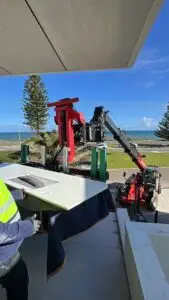
Telehandler or crane truck
Both put material on the level, and they suit different jobs. Our Manitou telehandler reaches up to 18 metres, which suits tight sites, balconies and sites with power lines nearby. It is the one for a steady run of pallets, plasterboard, benchtops and windows. Our crane trucks (15 metre and 21 metre) are the better call for Hebel, timber and steel frames or heavy single items. We will tell you honestly which one your job needs.
What is likely to happen next (our view)
Scenario one: approvals stay strong. The pipeline is deep, so the squeeze lands in November and December. Machines and operators book out, and builders who leave upper floor deliveries until the last minute pay in waiting time.
Scenario two: approvals soften. National dwelling approvals fell 6.1 per cent in August, so a cooler patch is plausible. Labour is still the tight input, and every hour spent carrying material is an hour not spent building.
Either way, placing material by machine, on the upper level, is becoming the sensible default for two-storey work and higher.
The takeaway
If your upper floor deliveries still end at the kerb, it is worth costing the carry. Count the crew hours, the breakages and the fatigue, then compare.
Your crew will thank you, especially as it warms up and nobody wants to carry material upstairs.
Want to trial it? Ring us on 08 8463 1029 or book an upper floor delivery. No dramas. Delivered.
<>